Crimson Desert Is Messy, Massive, and I Can't Stop Playing It

I didn't expect to like Crimson Desert this much.
Pearl Abyss made Black Desert Online, an MMO I bounced off hard because it felt like a second job with prettier graphics. When they announced Crimson Desert as a spinoff, I didn't care. When they pivoted to single-player and started showing trailers that looked impossibly ambitious, I was skeptical.
Games that try to do everything usually do nothing well. That's just how it works.
But Crimson Desert launched March 19th, sold 3 million copies in the first week, and I've now put about 50 hours into it. Here's the thing: it's messy, it's overwhelming, the story is a disaster, and I genuinely can't stop playing.
The Scale Is Hard to Describe
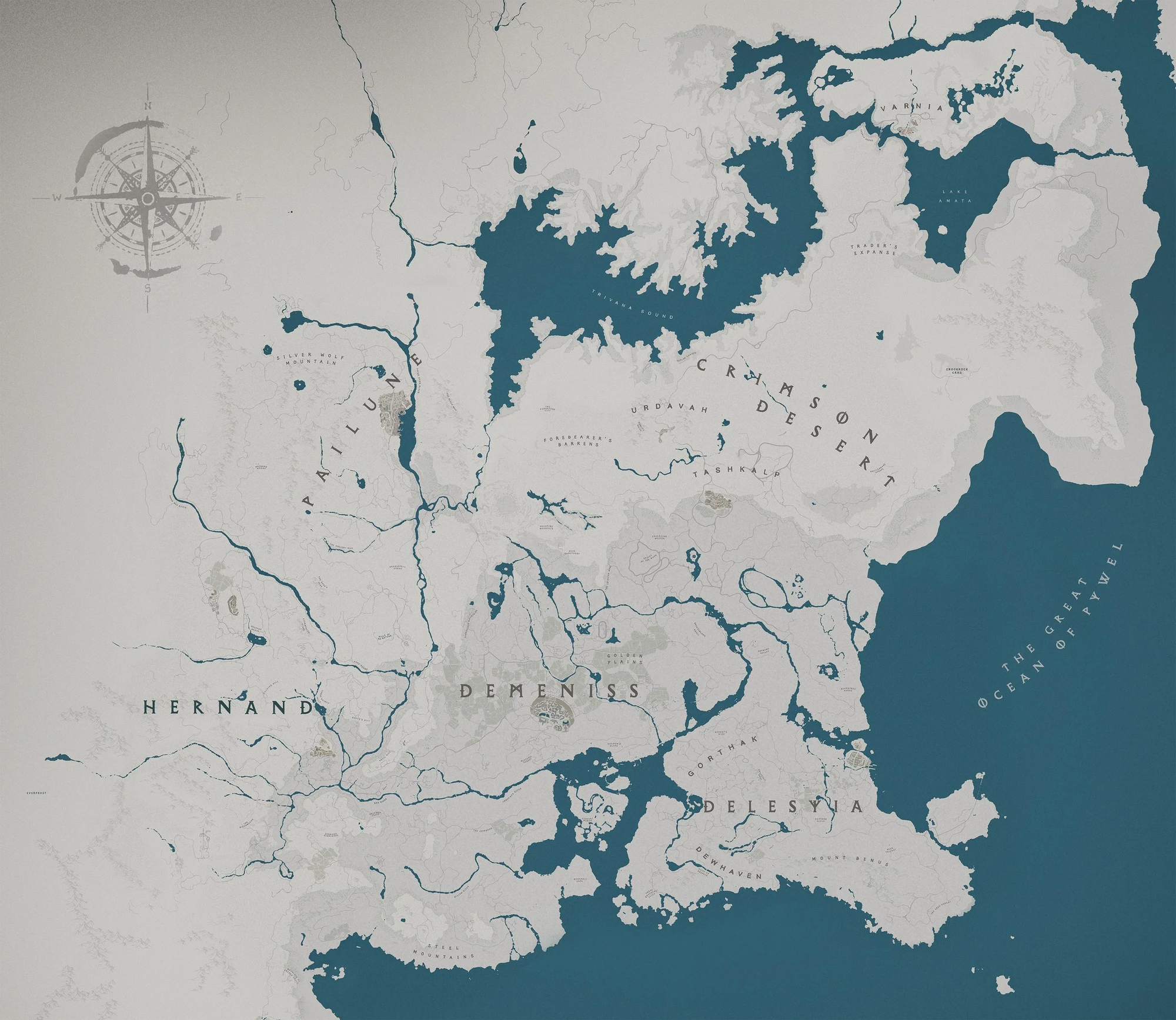
The continent of Pywel is massive. That word gets thrown around a lot for open-world games, but I mean it literally. The map is estimated at twice the size of Skyrim and larger than Red Dead Redemption 2.
It takes roughly four hours to walk from one end to the other. Not sprinting. Not on horseback. Walking.
And unlike some open worlds that achieve size through empty space and copy-pasted assets, Pywel is dense. Every region feels distinct. Snow-covered mountain ranges transition into lush forests into arid deserts into coastal cities. There's a clockwork city where mechanical beings tend farms. There are ruins floating in the sky. There's an entire underground region called the Abyss that I've barely touched.
The whole world renders as one continuous location. No loading screens between areas. You can stand on any high point and literally see every inch of the map. The first time I flew on a dragon mount and looked down at the full scale of it, I audibly said "what the hell" to nobody.
The List of Things You Can Do Is Absurd
This is where Crimson Desert goes from impressive to genuinely unhinged.
You can:
- Run a mining operation
- Manage investment banking
- Manufacture and trade dyes
- Build civil infrastructure
- Bounty hunt
- Pilot mechs with jet propulsion
- Compete in sumo wrestling
- Import and export goods
- Hustle at cards
- Solve puzzles in ancient ruins
- Decorate your house
- Catch bugs
- Collect cookbooks
- Operate siege artillery
- Work as a detective
- Carry live porcupines to mountaintops for no discernible reason
That's not a complete list. I'm 50 hours in and I'm still finding new systems I didn't know existed.
The game opens up almost immediately after the prologue. Here's the main quest. Here's the world. Go do whatever you want. Come back when you feel like it. The main story is technically urgent (your mercenary company got slaughtered, you're trying to reunite the survivors and get revenge), but the game never actually pressures you to pursue it.
I spent six hours yesterday managing a trading company and breeding horses. The main quest can wait.
The Influences Are Obvious and That's Fine
Crimson Desert wears its inspirations on its sleeve.
The exploration philosophy is pure Breath of the Wild. No yellow paint marking climbable surfaces. No glowing paths showing you where to go. See something interesting in the distance? Walk toward it. Climb it. Find out what's there.
The quest design echoes The Witcher 3. Side quests aren't fetch quests with a thin narrative wrapper. They're actual stories with characters and consequences and moral ambiguity.
The combat has Dragon's Dogma weight. Attacks have impact. Positioning matters. You can chain weapon skills with bare-handed strikes and grapples for seamless combo strings.
The world density takes cues from Red Dead Redemption 2. Random encounters. Emergent stories. The sense that the world exists whether you're looking at it or not.
Normally, this many obvious influences would make a game feel derivative. A checklist of features from better titles. But Crimson Desert synthesizes them at a scale I haven't seen since Rockstar was at their peak. The execution is confident enough that it stops feeling like imitation and starts feeling like evolution.
The Story Is Not Good
I have to be honest about this: the main narrative is a mess.
You play as Kliff, leader of the Greymanes mercenary company. Your people get ambushed by the rival Black Bears faction. You die, get resurrected by mysterious supernatural forces, and set out to reunite your scattered comrades and kill the enemy leader Myurdin.
That's a fine premise. The problem is the execution.
The plot fluctuates between confusing and nonsensical. Characters appear without introduction, spout exposition about factions and histories I'm supposed to care about, then disappear. Cutscenes happen that clearly assume emotional investment the game hasn't earned. Major story beats feel rushed while minor scenes drag on forever.
Kliff himself is... fine. He's competent and occasionally sarcastic and clearly cares about his people. But he's not memorable. Compare him to Geralt or Arthur Morgan or even Aloy, and he feels like a blank template where a protagonist should be.
The story isn't bad enough to actively harm the experience. It's just forgettable. A vessel for getting you from one spectacular setpiece to the next.
And honestly? That might be intentional. The real story of Crimson Desert is the world itself. The narrative is almost secondary to the experience of existing in Pywel and discovering its secrets.
The Technical Stuff
I'm playing on PC with a 4070 Super. Performance has been solid at 1440p with mostly high settings. The game looks gorgeous, particularly the lighting and environmental detail. Some of the vistas are screenshot-worthy in a way few games achieve.
One major caveat: Crimson Desert does not support Intel Arc GPUs. At all. Pearl Abyss has explicitly told affected users to get a refund. Intel apparently reached out multiple times during development, offered early hardware access and optimization help, and Pearl Abyss passed. It's a weird situation that Intel is understandably frustrated about.
If you're on Arc, wait and see if they add support post-launch. For Nvidia and AMD users, you're fine.
The game is also available on PS5 and Xbox Series X|S with comparable performance. Mac support exists through the Apple Silicon version, though I haven't tested that personally.
Who Is This For
Crimson Desert is for people who loved Breath of the Wild's sense of discovery but wished it had more structured content to find.
It's for people who miss when open-world games felt like genuine adventures rather than map-clearing exercises.
It's for people who want 100+ hours of content and don't mind that some of it will be rough around the edges.
It's not for people who need a strong narrative throughline. It's not for people who want guided experiences. It's not for people who find too many options overwhelming.
If you bounced off Elden Ring for being too hands-off, you'll probably bounce off this too. Crimson Desert expects you to engage with its systems on your own terms. The game provides the sandbox; you provide the motivation.
The Verdict (If I Had to Give One)
Crimson Desert is my favorite game I can't objectively call great.
The story is weak. Some systems are underbaked. The pacing in the main quest is all over the place. There are quality-of-life features missing that other games figured out years ago.
But I've put 50 hours into it and I'm not close to done. I keep finding new things. New regions to explore. New activities I didn't know existed. New stories tucked away in corners of the map that feel like secrets meant just for me.
Pearl Abyss built something genuinely ambitious. It doesn't all work. But enough of it works that I keep coming back. And in a gaming landscape full of safe, predictable releases, that ambition counts for a lot.
If you've got the time and the hardware, it's worth experiencing. Just don't expect the story to carry you. The world is the point.
Sources: